Agentic Workflows: What AI Agents Actually Do at Work
Agentic Workflows: What AI Agents Actually Do at Work
Everyone's talking about AI agents. Most of what they're saying doesn't match what agents actually do inside a real business operation.
The hype cycle around agentic AI has produced a lot of vague promises — "autonomous systems," "self-healing pipelines," "AI that thinks for you." What it hasn't produced is a clear picture of where agents earn their keep, where they don't, and what separates an agent that creates real operational value from one that just looks impressive in a demo.
This article cuts through the noise. You'll walk away knowing exactly what agentic workflows are, where they belong in your business, and what the handoff between AI and human judgment should actually look like.
What an AI Agent Actually Is
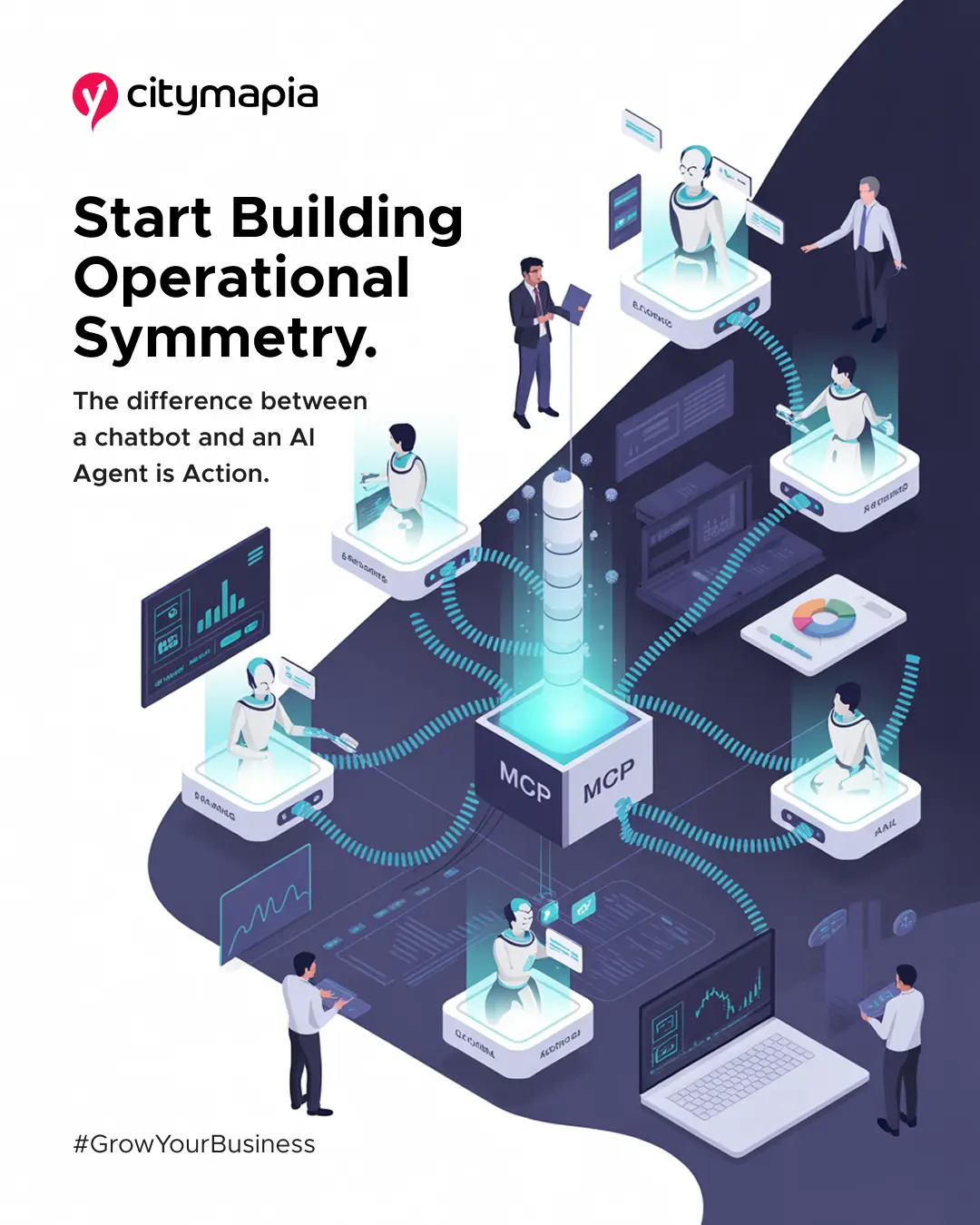
An AI agent isn't a smarter chatbot. It's an intelligent architecture — connected directly to your enterprise data, your workflows, and your business rules — that can observe, reason, and act without waiting to be asked.
Deterministic Partners, Not Magic Boxes
The word "autonomous" makes a lot of people nervous. It shouldn't — as long as the architecture is built correctly. A well-engineered AI agent operates deterministically: it follows defined rules, respects escalation paths, and acts only within the boundaries your team sets.
- Connected to live enterprise data via MCP (Model Context Protocol)
- Actions are predefined — the agent doesn't improvise
- Outputs are traceable and auditable
- Guardrails are built in at the infrastructure level, not bolted on afterward
An AI agent that surprises you is a badly built AI agent. Predictability isn't a limitation — it's the entire point.
Active Observation vs. Passive Response
Traditional tools wait. You log in, you pull a report, you run a query. An AI agent monitors signals continuously — and when a threshold is crossed, it acts. This shift from reactive to proactive is what makes agentic workflows genuinely different from standard automation.
- Inventory risk detected → alert sent before a stockout occurs
- Lead score crosses a threshold → follow-up triggered automatically
- Support queue spikes → routing logic adjusts in real time
Where Agentic Workflows Deliver Real Value
Not every workflow benefits from an agent. The highest-return use cases share a common trait: they're high-frequency, rules-driven, and currently eating time your team can't afford to spend.
Turning Data Into Decisions
The average operations team spends a significant chunk of their week doing work that shouldn't require a human at all — fetching reports, cross-referencing dashboards, summarizing metrics for leadership. Agents handle this entire layer.
- Complex reports summarized and delivered on a schedule
- Metrics fetched and qualified before your team ever looks at them
- Anomalies flagged with context, not just raw numbers
Your team stops hunting for data and starts acting on it.
Reducing Operational Drag
Operational drag is the quiet killer of scaling businesses. It's the manual coordination, the repeated back-and-forth, the "someone has to check on that" tasks that stack up across every department. Agentic workflows are purpose-built to absorb this drag.
- Appointment coordination handled end-to-end
- Parameter errors caught and corrected without a ticket being opened
- Onboarding sequences triggered automatically when conditions are met
- Approval workflows routed to the right person at the right moment
Operational drag compounds. Every hour spent on coordination is an hour not spent on the decisions that actually move the business forward.
Running Your Playbook Automatically
One of the most underappreciated capabilities of a well-built agent is playbook execution. Your business already has rules — for how leads are handled, how escalations flow, how exceptions are managed. An agent learns those rules and runs them without anyone having to remember to do it.
- Escalation paths followed exactly as designed
- No "manual hunt" for where a task currently sits
- Context passed between systems so nothing gets lost in handoffs
This is what Citymapia means by operational symmetry — AI that doesn't fight your existing logic, but executes it at a speed and consistency no manual process can match.
Where Human Oversight Must Stay
Agentic workflows are powerful. They're not a replacement for judgment. The companies that deploy agents most effectively aren't the ones trying to automate everything — they're the ones who are precise about what should stay human.
Strategic Direction
An agent can tell you what's happening across your operations in real time. It can't tell you where you want to take the business. Vision, positioning, and long-term strategic calls belong to leadership — and they always will.
High-Stakes Governance
When automated actions carry real consequences — financial commitments, public-facing communications, contractual decisions — human review is non-negotiable. Agents should surface these moments clearly and hand off cleanly, not proceed by default.
The "What" and the "Why"
AI handles the repetitive "how." Your team owns the "what" and the "why." That's not a limitation of current technology — it's the correct division of cognitive labor. The goal isn't full autonomy. It's freeing up your best people to do the work that actually requires them.
Common Mistakes to Avoid
- Treating agents as chatbot upgrades — An agent connected to your data and workflows is a fundamentally different system from a conversational interface; confusing the two leads to underinvestment in the infrastructure that actually matters.
- Automating without defining guardrails first — An agent without clear boundaries will eventually take an action you didn't intend; define escalation paths and exception handling before deployment, not after.
- Starting with the flashiest use case — The highest-ROI deployments are usually the least glamorous ones: the repetitive, rules-driven tasks that drain your team every single day.
- Skipping the context layer — Agents that don't have access to your business history, your customer data, and your specific rules make generic decisions; context-aware architecture is what separates a useful agent from a liability.
Frequently Asked Questions
What's the difference between AI automation and an agentic workflow?
Standard automation executes a fixed sequence of steps when triggered. An agentic workflow observes live signals, applies contextual reasoning, and decides what action to take based on your defined rules — without needing a specific trigger from a human. It's the difference between a rule that fires when a button is pressed and a system that notices the button needs pressing.
Do we need to replace our existing tech stack to use AI agents?
No. A properly engineered agent integrates with your current systems — your CRM, your internal dashboards, your communication tools — via protocols like MCP. You don't rebuild from scratch. You add an intelligent layer that connects what you already have and makes it faster.
How do we make sure agents don't take actions we didn't approve?
Through guardrails defined at the infrastructure level. Every agent built by Citymapia operates within explicit boundaries: predefined action types, clear escalation paths, and human approval requirements for high-stakes decisions. The agent doesn't improvise — it executes the rules your team sets.
What size business benefits most from agentic workflows?
Any business with repetitive, rules-driven operations that are currently handled manually. The ROI scales with volume — the more frequently a task repeats, the faster an agent pays for itself. That said, even smaller teams see meaningful impact when agents absorb coordination and reporting work that pulls people away from higher-value tasks.
How long does it take to deploy an agentic workflow?
With the right infrastructure already in place, individual workflows can go live in days, not months. The timeline depends less on the agent itself and more on how clearly your existing business rules are defined. The cleaner your logic, the faster the deployment.
Ready to Build Workflows That Actually Work?
Citymapia designs agentic infrastructure that fits your operations — not the other way around. Stop patching manual processes. Start scaling with systems built to run your playbook.
Build With Citymapia