Why Indian Small Businesses Can't Afford to Stay Offline
Why Indian Small Businesses Can't Afford to Stay Offline
If your business isn't online, it doesn't exist for most of your customers — and that gap is costing you more than you think.
India has over 63 million MSMEs. They power local economies, employ hundreds of millions, and form the backbone of the country's commercial fabric. Yet the vast majority of them have no website, no digital storefront, and no way for new customers to find them outside of a physical address or word-of-mouth.
That's not a technology problem. It's a visibility problem. And it has a straightforward fix.
What a Website Actually Does for Your Business
Most people think of a website as a digital business card — something you set up once and forget. That framing misses everything that matters.
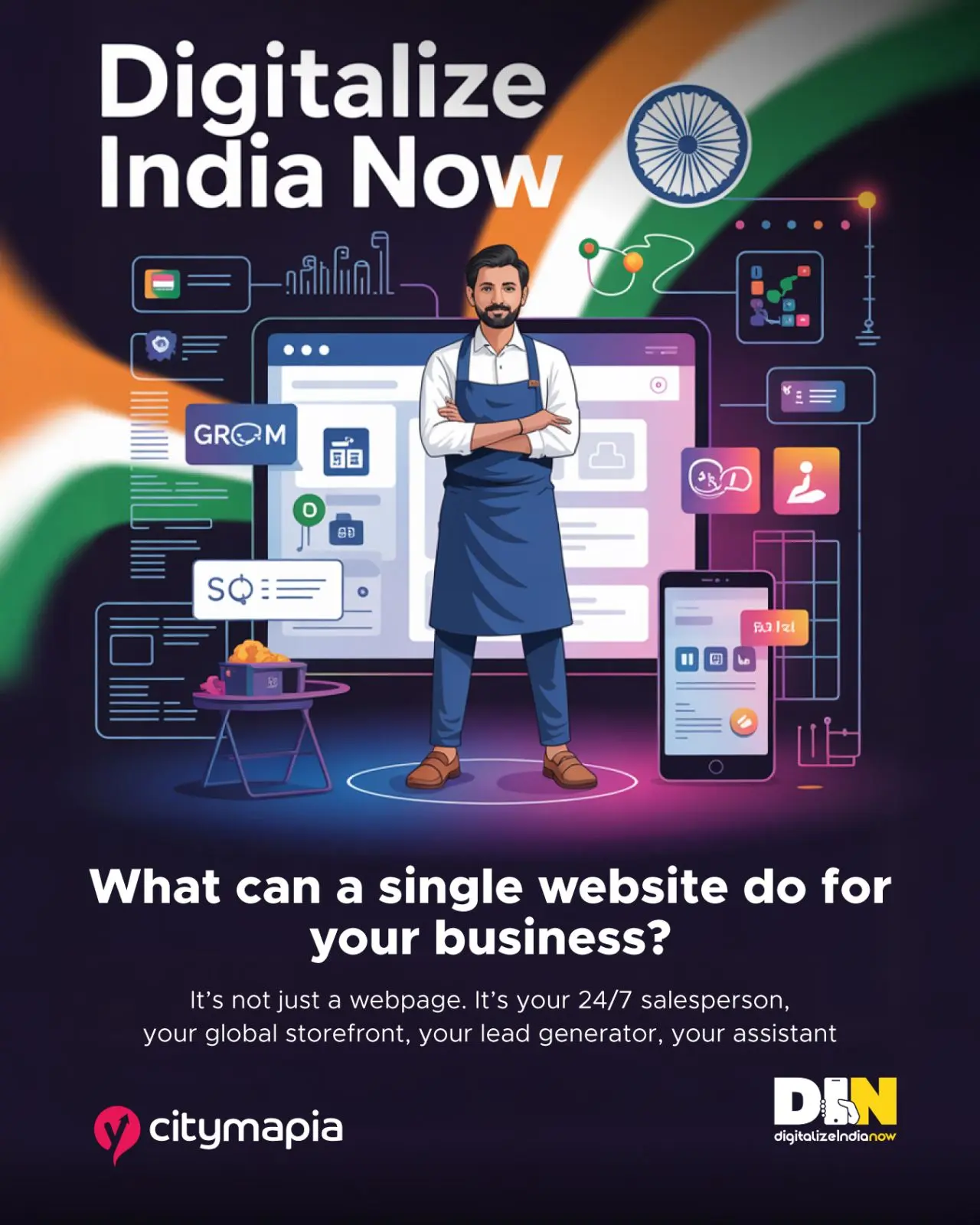
A professional website is an active business asset. It works across time zones, handles inquiries you're too busy to answer, and builds trust with customers before you've exchanged a single word.
It's Your 24/7 Salesperson
Your shop closes. Your team logs off. Your website doesn't. Every hour you're not working, your website is still representing your business — answering questions, showcasing your products or services, and guiding potential customers toward a decision.
- Product or service information available at any time
- Contact forms and inquiry capture running around the clock
- Testimonials and credentials building trust before the first call
- Local SEO driving nearby customers directly to your door
A well-built website isn't a cost. It's the hardest-working employee you'll ever have — and it never calls in sick.
It's Your Automated Lead Generator
When someone searches for a service in your city, they're not browsing directories — they're going straight to Google. Without a website, you don't appear. With one, you're competing. With a well-optimised one, you're winning.
- Show up in local search results for high-intent queries
- Capture leads through contact forms and WhatsApp integrations
- Convert visitors into paying customers without a sales call
The Real Cost of Staying Offline
The businesses that stay invisible don't just miss new customers — they quietly lose existing ones. When a customer wants to refer you to someone, what do they share? When a new buyer wants to verify your credibility before calling, where do they look? Without a website, those moments either fall flat or go to a competitor who has one.
There's also a trust gap that's widening fast. Consumers — even in smaller cities and towns — now expect a business to have a digital presence. Its absence raises a question before the conversation even starts.
- No website means no Google Business verification support
- No digital presence means no share-able proof of credibility
- Competitors with websites absorb the customers you're not capturing
- Offline businesses are increasingly invisible to the under-35 buyer
Why Most Small Businesses Haven't Gone Online Yet
It's rarely a lack of interest. The more common barriers are cost, complexity, and the assumption that digital is something built for bigger companies.
Affordable options have historically been either too generic to be useful or too technical to manage without a full IT team. That's left a massive segment of India's business community — the kirana store, the local consultant, the workshop, the boutique — with no practical path to a real digital presence.
That's exactly the gap Digitalize India Now (DIN), an initiative by Citymapia, was built to close.
DIN's mission is straightforward: bring India's micro and small businesses online — affordably, powerfully, and without unnecessary complexity.
What Citymapia Builds Differently
Most web design services give you a page. Citymapia builds you an asset.
The distinction matters. A page is static — it sits there. An asset works: it attracts traffic, converts visitors, integrates with the tools your business already uses, and grows with you. That's the philosophy behind every website built under the DIN initiative.
- Built for discoverability — structured for search engines from day one
- Designed for conversion — every page has a purpose and a next step
- Mobile-first — because most of India browses on a phone
- Affordable and scalable — built to grow alongside the business
- No technical knowledge required from the business owner
The goal isn't just to put businesses online. It's to make sure being online actually changes something for them.
Common Mistakes to Avoid
- Treating a website as a one-time project — A website needs to be maintained, updated, and optimised to keep delivering results over time.
- Skipping mobile optimisation — Over 75% of Indian internet users access the web on mobile; a desktop-only design loses most of your traffic before it lands.
- No clear call to action — A website without a prompt — call now, send a message, get a quote — is a brochure with no follow-through.
- Ignoring local SEO — Ranking for your city and category is often easier than ranking nationally, and far more valuable for most small businesses.
- Waiting until the business is "bigger" — A website helps you grow. Waiting until you've grown to build one reverses the logic entirely.
Frequently Asked Questions
How much does it cost to build a website for a small business in India?
Costs vary widely depending on what you need, but the DIN initiative by Citymapia is specifically designed to make professional websites accessible and affordable for micro and small businesses — without compromising on quality or functionality.
Do I need technical knowledge to manage my website?
No. Websites built under DIN are designed so that business owners can manage basic content updates without any coding knowledge. The technical heavy lifting is handled on your behalf.
Will a website actually bring in new customers?
Yes — if it's built for search visibility and conversion. A properly structured website with local SEO puts your business in front of people actively searching for what you offer in your area.
How long does it take to get a small business website live?
Timelines depend on the scope and content, but a focused small business website can typically go live within a few weeks when content and requirements are provided promptly.
Is a website necessary if I already get customers through WhatsApp or referrals?
Referrals are valuable — but a website multiplies them. It gives people something to share, builds credibility for those hearing about you for the first time, and opens a channel that referrals alone can't reach.
Ready to Put Your Business on the Map?
See how Citymapia's DIN initiative helps Indian small businesses build a powerful digital presence — affordably and without the complexity.
Get Started with Citymapia