E-commerce Automation That Recovers Sales and Scales Growth
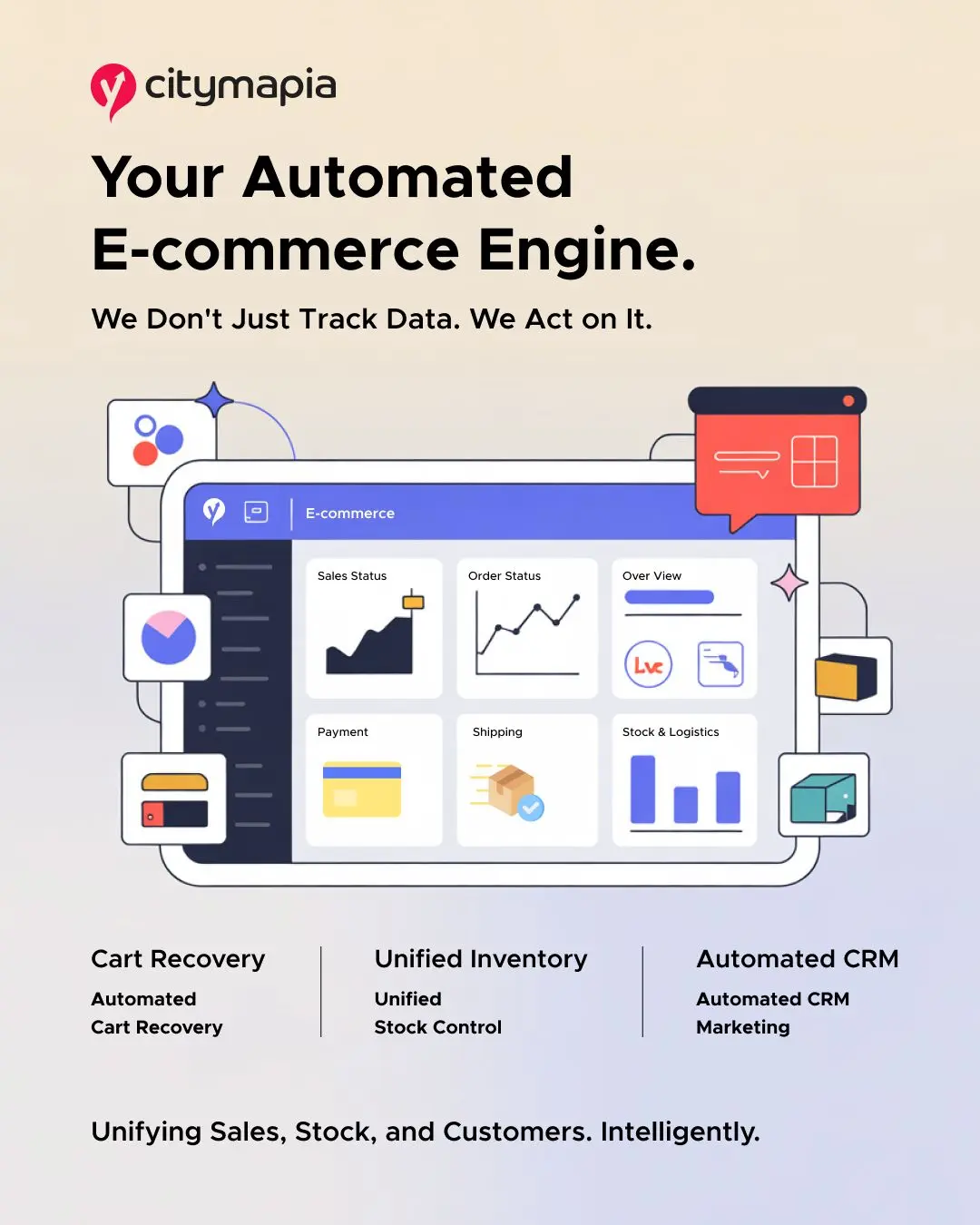
E-commerce Automation That Recovers Sales and Scales Growth
Every day, online stores watch customers add products to cart — and quietly disappear. No follow-up. No recovery. Just lost revenue sitting in an abandoned session log that nobody acts on.
Most e-commerce platforms are built to display your performance. They give you charts, conversion rates, and drop-off percentages. What they don't do is respond to that data automatically — at the exact moment it matters.
This blog breaks down how e-commerce automation actually works in practice: what it recovers, what it unifies, and how Citymapia's platform is engineered to act on your data instead of just presenting it.
Why "Seeing Your Data" Is No Longer Enough
There's a gap in most e-commerce operations — and it's not a technology gap. It's a reaction gap. Data comes in, sits in a dashboard, and waits for someone to notice it. By the time a decision gets made, the moment has passed.
A customer who abandoned their cart at 11 PM isn't going to wait for your marketing team to pull a report on Monday morning. That window is hours wide, not days.
The businesses winning in e-commerce right now aren't just collecting data — they're building systems that respond to it automatically, in real time, without human intervention.
That's the core principle behind e-commerce automation done right. Not more dashboards. Fewer delays between signal and action.
Automated Cart Recovery: Turning Abandonment Into Revenue
Cart abandonment is one of the most consistent revenue leaks in e-commerce. Across the industry, the majority of shoppers who add items to a cart never complete the purchase. Most stores accept this as normal. It isn't — it's recoverable.
Why Standard Recovery Tactics Fall Short
Email-based cart recovery has existed for years. The problem? Inboxes are crowded, open rates have dropped, and a recovery email that arrives six hours late is often irrelevant. Customers have already moved on — or bought elsewhere.
- Email recovery open rates continue to decline year over year
- Generic "You forgot something!" messages don't create urgency
- Delayed triggers miss the purchase intent window entirely
- No personalization means no real reason to return
WhatsApp Recovery: Where Customers Actually Respond
Citymapia's cart recovery works through WhatsApp — a channel where open rates are dramatically higher and responses happen within minutes. When a customer who's opted in adds items to cart and exits, the platform identifies that signal and triggers a recovery notification through WhatsApp automatically.
- Triggered the moment abandonment is detected — not hours later
- Delivered on a channel the customer already uses daily
- Personalized to the actual items left behind
- No manual campaign setup required per customer
It's not a blast message. It's a precisely timed, contextual nudge — sent while the purchase intent is still warm.
Unified Inventory: One Source of Truth Across Every Channel
Running inventory across an online store and physical locations simultaneously is one of the most error-prone operations in retail. Stock gets updated in one system and not the other. Products show as available online when they've already sold out in-store. Overselling happens. Customers get frustrated. Trust erodes.
The Real Cost of Disconnected Inventory
Beyond customer experience, fragmented inventory creates internal inefficiencies that compound over time.
- Staff manually reconciling stock across systems every day
- Refunds and cancellations caused by overselling
- Missed restocking signals because data lives in two places
- Slow order fulfillment when picking from inaccurate counts
Unified inventory management isn't a feature upgrade — it's a foundational fix that removes an entire category of operational error from your business.
How Citymapia Unifies Your Stock
Citymapia's Unified Inventory Management merges your online and offline stock into a single real-time system. Every sale — whether through your e-commerce store or at a physical counter — updates the same source of truth instantly.
- Live stock counts visible across all channels at once
- Automatic prevention of overselling when stock hits zero
- Restocking alerts triggered by real movement, not guesswork
- No manual syncing between platforms
Your team stops firefighting inventory discrepancies and starts focusing on what actually grows the business.
Automated CRM: Your Customer Database, Put to Work
Most businesses have a customer database. Few are using it actively. Contact lists sit in a CRM that gets opened when someone needs to send a newsletter — and that's about it.
That's a significant missed opportunity. Every customer record in your database represents a relationship that has already been established. The hard part — acquisition — is done. Keeping that customer engaged and buying again is where automation pays for itself fastest.
What Automated CRM Communication Looks Like in Practice
Citymapia's integrated CRM doesn't wait for you to schedule a campaign. It sends automated, behaviour-triggered communications via WhatsApp and SMS based on what your customers actually do.
- Post-purchase follow-ups sent automatically after an order ships
- Loyalty offers triggered when a customer hits a spending threshold
- Restock alerts sent to customers who previously viewed an out-of-stock item
- Re-engagement messages for customers who haven't purchased in a set period
- Seasonal offers delivered through the channels they respond to most
Each touchpoint is contextual. Each one is triggered by real customer behaviour — not a marketer manually segmenting a list and hoping the timing works out.
How These Three Systems Work as One Engine
Cart recovery, inventory unification, and automated CRM aren't three separate features bolted together. On Citymapia's platform, they operate as a connected loop.
A customer browses your store. If they abandon their cart, recovery triggers automatically. If they return and purchase, inventory updates instantly across every channel. That purchase event then feeds back into the CRM, making the customer eligible for post-purchase follow-up or loyalty rewards — all without anyone touching a dashboard.
- Every part of the customer journey is accounted for
- Data flows through the system instead of sitting in silos
- The platform responds to behaviour instead of waiting for instructions
- Growth happens in the background while your team focuses elsewhere
This is what a unified e-commerce engine actually means. Not a suite of tools. One system that connects the dots and acts.
Common Mistakes to Avoid
- Treating cart abandonment as an acceptable loss — A significant share of abandoned carts are recoverable with the right timing and channel; writing them off is leaving real revenue on the table.
- Managing online and offline inventory separately — Every hour those two systems are out of sync is an hour where overselling, stock errors, or poor customer experiences can happen.
- Running CRM campaigns manually — Manual sends are slow, imprecise, and don't scale; automated triggers based on customer behaviour consistently outperform batch-and-blast approaches.
- Choosing tools that don't communicate with each other — A cart recovery tool that doesn't sync with your inventory or CRM creates new data gaps even as it solves old ones.
- Waiting until your operation is "big enough" to automate — Automation is most valuable precisely when the business is still small enough to implement it without large-scale disruption.
Frequently Asked Questions
What is e-commerce automation and how does it work?
E-commerce automation uses software to perform repetitive or time-sensitive tasks — like sending cart recovery messages, updating inventory counts, or triggering customer communications — without requiring manual input. When a customer takes an action, the system detects it and responds according to pre-set rules, in real time.
How effective is WhatsApp for cart recovery compared to email?
WhatsApp consistently delivers significantly higher open and response rates than email, particularly in markets across South Asia, Southeast Asia, and the Middle East where it's the dominant messaging platform. Because messages arrive in a space customers already actively use, the recovery window stays open much longer than it would in a crowded inbox.
Can unified inventory management work for small businesses with just one physical store?
Yes — and the benefits are arguably more immediate for smaller operations. With fewer staff and tighter margins, a single oversell or stock discrepancy has a proportionally larger impact. A unified system removes that risk entirely, regardless of how many locations you're running.
Will integrating an automated CRM require replacing our existing customer database?
Not necessarily. Citymapia's platform is designed to work within your existing infrastructure rather than replace it. The goal is to activate the data you already have — not to start from scratch or force a full migration before you see results.
How long does it take to set up e-commerce automation with Citymapia?
Implementation timelines vary depending on the complexity of your current systems, but Citymapia is built to deploy quickly without requiring a complete platform rebuild. Most businesses begin seeing automated activity — recovered carts, unified stock updates, triggered CRM sends — well before a full rollout is complete.
Stop Managing Your Store. Let It Run Itself.
See how Citymapia's automated e-commerce engine recovers revenue, unifies your inventory, and keeps customers coming back — without the manual work.
Explore Citymapia