From Local Depth to Global Scale: The Citymapia AI Blueprint
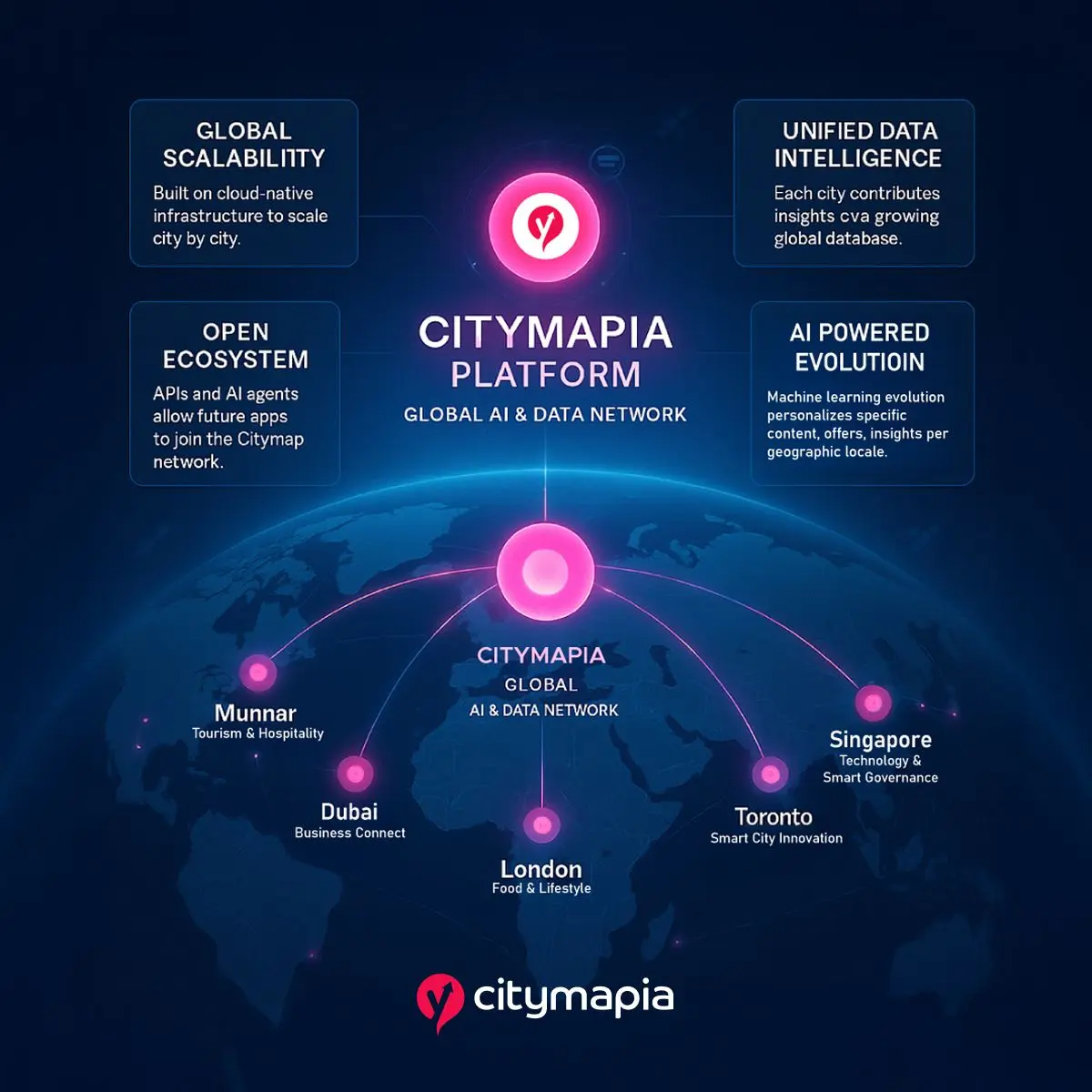
From Local Depth to Global Scale: The Citymapia AI Blueprint
The companies that win global markets aren't the ones that expanded fastest. They're the ones that built something so precise at the local level that scaling it became inevitable.
Most platforms chase reach. They launch across dozens of cities before they've truly understood even one. The result is data that looks impressive in a board deck but fails to serve actual users — stale directories, generic recommendations, and an experience that could belong to anyone, anywhere.
Citymapia is doing the opposite. And the AI and data infrastructure behind it is why this approach doesn't just work — it compounds.
Why Local Intelligence Has to Come First
Before any conversation about global scale, it's worth being precise about what "local depth" actually means — and why it's genuinely hard to build.
It's not about having a business listing for every restaurant in a city. Any scraper can do that. Real local intelligence means understanding context: the neighborhood dynamics, the cultural signals, the way people in Kozhikode search differently than people in Kochi, even within the same state. It means content that reflects the people who actually live there.
That's the philosophy behind Citymapia's core principle: Every City Has a Page, and Every Page Reflects Its People. This isn't a tagline. It's an architectural constraint that shapes how the entire data network is built and what the AI is trained to do.
What Makes Hyperlocal Data Different
Hyperlocal data has properties that city-level or country-level data simply doesn't. It's noisier, faster-moving, and far more culturally specific. Getting it right requires:
- Continuous signal collection from real user behavior — not static inputs
- Content systems that understand regional language and local context
- Feedback loops that update relevance rankings in near-real-time
- Infrastructure that treats each city as its own data domain, not just a row in a larger table
When you build this at the local level first, you end up with something rare: high-fidelity data that can actually train machine learning models to personalize meaningfully — not just filter by distance.
A platform that gets local right doesn't need to reinvent itself when it goes global. It just needs to replicate what already works.
Unified Data Intelligence: When Local Signals Connect
The value of local depth multiplies the moment you start connecting it. Citymapia's Unified Data Intelligence layer is what turns hundreds of independent city datasets into a coherent, queryable, and increasingly predictive network.
The system doesn't just aggregate data from multiple cities — it identifies patterns across them. A trend emerging in Bangalore's food discovery behavior might predict what users in Chennai want six weeks from now. A content format gaining traction in Hyderabad may be worth testing in Mumbai before it surfaces there organically.
Three Capabilities This Unlocks
- Cross-city personalization: Users who move between cities get relevant discovery immediately, not after weeks of the system re-learning their preferences
- Predictive content modeling: Machine learning identifies rising categories and businesses before they become mainstream searches
- Network-wide quality signals: High-quality local data from established hubs improves the baseline for newly launched cities from day one
Unified doesn't mean uniform. The intelligence layer amplifies what's distinct about each city — it doesn't erase it.
Cloud-Native Infrastructure Built for Replication
Going from India's tier-1 cities to international markets like London, Dubai, and Toronto isn't just a content challenge. It's an infrastructure challenge. The underlying systems need to handle language shifts, regulatory differences, latency requirements, and completely different discovery patterns — without requiring a rebuild every time.
Citymapia's cloud-native infrastructure is designed to replicate success, not just presence. Each new city launch inherits:
- Core AI models already trained on hundreds of millions of local data points
- Localization layers that adapt content, language, and ranking signals to the new geography
- Scalable indexing that onboards a new market's data without degrading performance for existing cities
- An open API ecosystem that allows third-party apps and agents to integrate into the network from day one
This is the advantage of building infrastructure deliberately rather than reactively. When a new city goes live, it's not starting from zero — it's starting from a tested foundation that already knows how to learn.
The Open Ecosystem Advantage
One of the most strategically significant elements of Citymapia's architecture is its open API layer. Allowing external applications and AI agents to join the network isn't just a developer relations decision — it's a compounding growth strategy.
Every app that integrates with the network contributes behavioral signals back into it. Every agent that queries the API refines what the system knows about demand patterns. The network becomes more valuable the more it's used — and that's the hallmark of platforms that achieve durable, defensible scale.
For businesses building on top of the network — local commerce tools, recommendation engines, city-specific assistants — this means access to a data substrate that would take years to build independently. For Citymapia, it means accelerating intelligence acquisition in new markets before organic data density builds up on its own.
Common Mistakes to Avoid
- Mistaking coverage for depth — Listing every business in a city isn't the same as understanding it. Coverage without behavioral data produces directories, not discovery engines.
- Globalizing too early — Expanding to new markets before the core data model is proven in existing ones creates technical debt that compounds across every future launch.
- Treating AI as a layer, not a foundation — Bolting machine learning onto a platform built without it produces brittle systems that can't personalize at scale.
- Ignoring the open ecosystem opportunity — Platforms that hoard their data don't grow as fast as platforms that share it strategically. APIs turn external developers into network contributors.
Frequently Asked Questions
How does Citymapia maintain local relevance as it scales internationally?
The platform's architecture treats each city as its own data domain with dedicated localization layers. Machine learning adapts content, ranking signals, and recommendations to geographic and cultural context rather than applying a one-size-fits-all global model.
What is Unified Data Intelligence and how does it benefit users?
It's the layer that connects signals across Citymapia's city-level datasets into a coherent network. For users, this means sharper personalization — especially when moving between cities or searching for categories that are emerging rather than already established.
Why does cloud-native infrastructure matter for a local discovery platform?
Cloud-native systems can replicate data models and AI logic to new geographies without full rebuilds. It's the difference between launching a new city in weeks versus months — with an intelligent baseline already in place from the first day.
How does the open API ecosystem improve the network's intelligence over time?
Every third-party integration generates behavioral signals that feed back into Citymapia's models. This creates a compounding data advantage — the more the network is used externally, the smarter it becomes for every user on the platform.
Is Citymapia only relevant for large metro cities?
No. The hyperlocal philosophy specifically values smaller, culturally distinct communities. The platform's architecture is built to capture nuance at the neighborhood level, making it especially well-suited to India's diverse, high-density smaller cities before expanding globally.
See the Network in Action
Explore how Citymapia is building the AI and data infrastructure that connects local depth to global opportunity.
Explore Citymapia