How Hyper-Local Indexing Builds Global Business Visibility
How Hyper-Local Indexing Builds Global Business Visibility
Most local businesses assume their digital presence ends at their city limits. Citymapia is proving that assumption wrong — at scale.
When 15,000+ businesses across India adopt a single platform as their primary digital deployment layer, something remarkable happens. Their local data — products, services, addresses, hours — stops being local. It becomes a globally indexed, search-ranked digital asset.
This article breaks down how hyper-local indexing works, why it's becoming the standard for modern business visibility, and what 1.5 lakh indexed Google pages tells us about where digital commerce is heading.
What Hyper-Local Indexing Actually Means
The term gets used loosely. Here's the practical definition: hyper-local indexing is the process of structuring a business's location-specific data — products, services, categories, geography — so that each element becomes its own discoverable content asset in search engines.
It's not a directory. It's an architecture.
Traditional business directories list your name, phone, and address. That's it. A hyper-local indexing architecture goes further. It builds a dedicated digital identity for each business — structured, optimized, and designed to rank independently.
- Each City Page functions as a standalone indexed node
- Every product or service listed generates its own searchable content layer
- The structure compounds over time — more businesses means more indexed pages, means more surface area in search
Local data, engineered correctly, doesn't stay local. It becomes a global discoverability engine.
Why the number 1.5 lakh matters
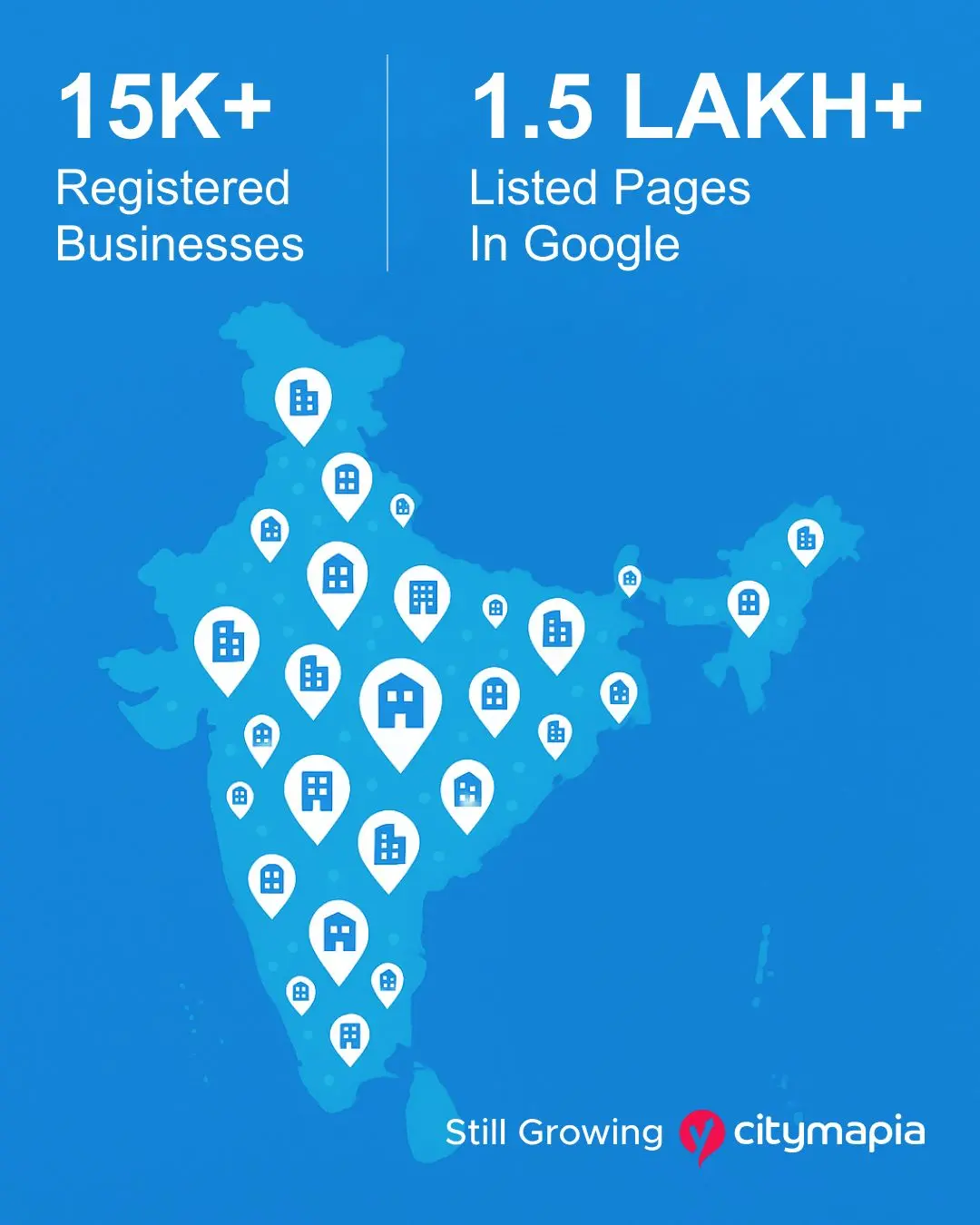
When Citymapia reports 1.5 lakh+ indexed pages on Google, that figure isn't just a vanity metric. Each page represents a business, a category, or a service that now has an independent chance of ranking — for local searches, long-tail queries, and category-level keywords that no single business could achieve on its own.
The Business Case for a Consolidated Digital Identity
Here's the friction most small and mid-sized businesses face: their catalog exists in five places — a WhatsApp catalogue, a Facebook page, a basic website, a Google Business profile, and maybe an Instagram account. None of them talk to each other. None of them are optimized. And none of them rank well.
A consolidated digital identity solves this by making one authoritative source the truth. Everything else syncs from it.
- Products and services indexed once, discoverable everywhere
- No duplicate content issues across platforms
- Consistent business information that builds domain trust
- SEO equity accumulates in one place instead of scattering
Scattered presence dilutes search authority. Consolidated presence compounds it.
How 15,000+ Businesses Create Network Effects
One business joining a local indexing platform creates marginal value. Fifteen thousand businesses doing it creates something different: a network with compounding authority.
Search engines don't just rank pages. They rank ecosystems. When a domain consistently publishes structured, location-rich, well-organized content at scale, it builds domain authority — the underlying trust score that determines how well any individual page performs.
What this means for registered businesses
- A new business joining the platform inherits ranking momentum from the network
- Category and city-level pages rank faster because of the platform's existing authority
- Long-tail queries become winnable — "best textile shop in Ernakulam," "affordable catering in Kochi"
This is why Citymapia's model isn't just a listing tool. It's a shared infrastructure play — and businesses that plug into it early get a compounding advantage over those that wait.
Common Mistakes to Avoid
- Treating local SEO as a one-time task — Search visibility degrades without consistent updates; your digital identity needs to stay current.
- Ignoring long-tail search queries — Most purchase-intent searches are hyper-specific; businesses that don't rank for them lose customers to competitors who do.
- Spreading catalog data across disconnected platforms — Fragmented listings split your SEO authority and make it harder for search engines to identify your business as authoritative.
- Waiting until the platform is "perfect" — Indexing takes time; every month you delay is a month of ranking potential you don't get back.
Frequently Asked Questions
What is hyper-local indexing and how is it different from a regular directory?
A directory lists your business. Hyper-local indexing structures your data so each product, service, and location becomes its own independently searchable content asset — with real ranking potential on Google.
How many pages does Citymapia have indexed on Google?
As of the latest reported figures, Citymapia has over 1.5 lakh (150,000) pages indexed on Google — each representing a business, category, or service from its registered partner network.
Does joining a platform like Citymapia improve my search ranking?
Yes. Businesses that join a platform with established domain authority benefit from network-level SEO momentum — particularly for city-specific and category-level search queries.
How long does it take for a new business listing to rank on Google?
Indexing typically takes days to weeks. Ranking — especially on competitive terms — takes longer and depends on content quality, category competition, and how well the listing is optimized.
Is Citymapia only for businesses in Kerala?
Citymapia's City Page architecture is designed to scale across any geography. While current traction is strong in Kerala and South India, the platform is built to support business visibility nationally and beyond.
Your Business Deserves to Be Found
Join 15,000+ businesses already building their digital authority on Citymapia.
Get Listed on Citymapia