How RAG AI Is Transforming ESG Data Into Decisions
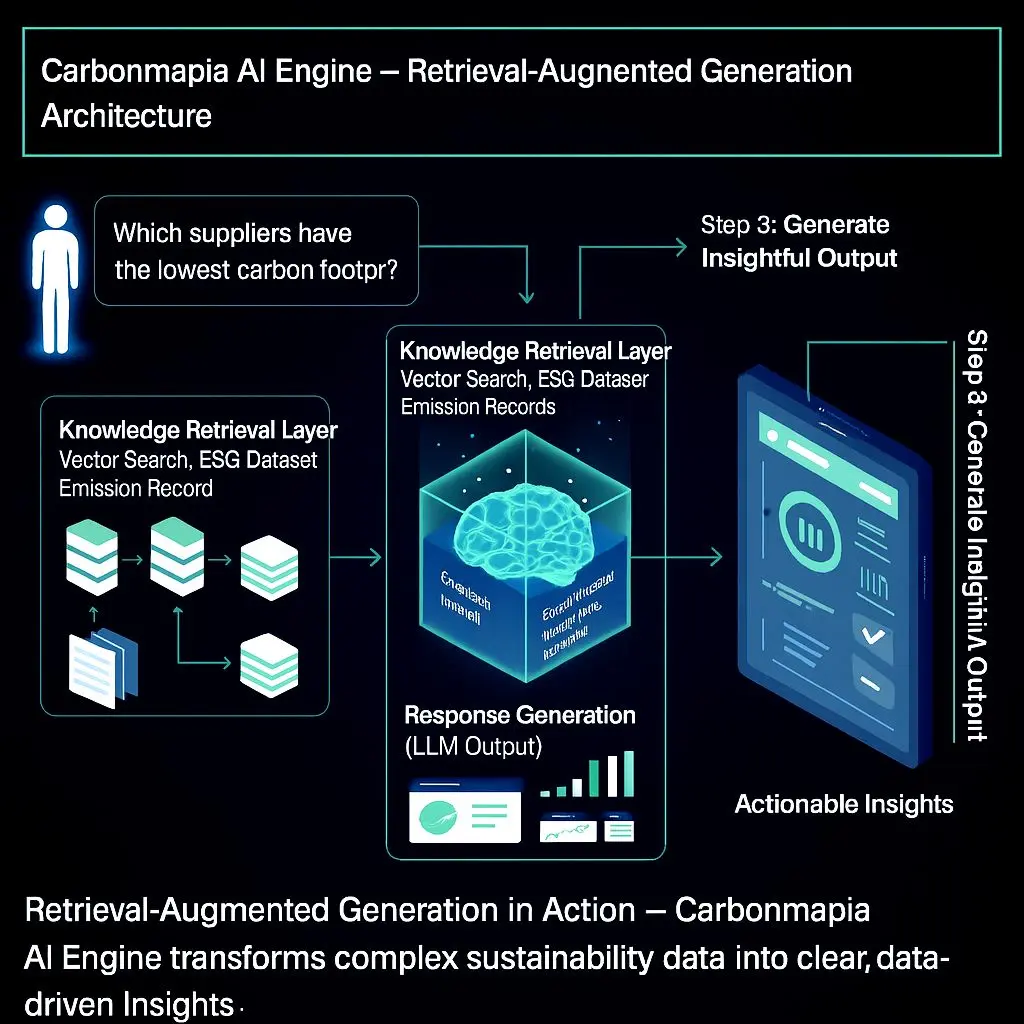
How RAG AI Is Transforming ESG Data Into Decisions
Most sustainability teams aren't short on data. They're short on answers — and the gap between the two is costing organisations time, credibility, and progress on their climate commitments.
ESG reporting has grown more demanding every year. Procurement teams need supplier-level carbon data. Sustainability leads need emission records that hold up under scrutiny. Regulators are pushing for transparency that most legacy systems simply weren't built to deliver.
Carbonmapia's AI Engine — built on a Retrieval-Augmented Generation (RAG) architecture — was designed to close that gap. This post breaks down what RAG actually is, how Carbonmapia applies it to ESG data, and why it's becoming essential infrastructure for organisations serious about sustainability intelligence.
What Is Retrieval-Augmented Generation (RAG)?
Most people have used a general-purpose AI that generates answers from its training data alone. That works for broad topics — but it fails badly when the questions are specific, the data is proprietary, or the stakes are high.
RAG is a different architecture. Instead of relying only on what the model was trained on, a RAG system first retrieves relevant information from a defined data source — then uses that context to generate a precise, grounded answer.
The Three-Step Process
Carbonmapia's AI Engine follows a clear workflow every time a query is submitted:
- Understand: The system interprets the natural language question — no technical syntax required
- Retrieve: It searches across verified ESG datasets, emission records, and internal data sources to pull the most relevant context
- Generate: The AI fuses that retrieved context with generative reasoning to deliver a precise, data-grounded answer — often with visual output
RAG doesn't guess. It finds, then reasons — which is exactly what ESG decision-making demands.
Why General AI Fails at ESG
ESG questions aren't abstract. "Which of our suppliers has the lowest Scope 3 footprint?" isn't a question a general AI can answer accurately — it requires access to your actual supplier data, matched against verified emission benchmarks.
- Generic AI models hallucinate when pushed beyond their training data
- ESG datasets change frequently — static training can't keep up
- Compliance demands sourced, verifiable answers — not approximations
How Carbonmapia Applies RAG to Sustainability Intelligence
The Carbonmapia AI Engine isn't a chatbot bolted onto a spreadsheet. It's purpose-built ESG infrastructure — designed to work with the complexity that sustainability data actually carries.
Natural Language Access to Complex Data
Teams can ask questions the way they think — not the way a database expects. Queries like "Which procurement categories are driving our emissions this quarter?" or "Show me suppliers with improving carbon trajectories" get answered instantly, with context pulled from real data.
- No SQL. No pivot tables. No waiting on an analyst
- Results that reference the actual underlying records
- Visual outputs that make patterns immediately clear
Verified Data, Traceable Answers
One of the most critical features for ESG use is traceability. Carbonmapia's RAG architecture doesn't just return answers — it returns answers sourced from identifiable datasets. That matters enormously when a sustainability report needs to withstand audit, regulatory review, or stakeholder scrutiny.
- Every insight is tied to a retrievable source
- Emission records, ESG disclosures, and internal data are all searchable
- Answers remain accurate as data is updated — no model retraining required
Sustainability reporting lives or dies on source integrity. RAG gives every answer a paper trail.
Who Benefits Most From This Architecture
Carbonmapia's AI Engine was built with three types of teams in mind — each of whom carries different responsibilities but shares the same core problem: too much data, too little clarity.
Sustainability Teams
These teams are often responsible for translating raw emission data into board-ready narratives and regulatory submissions. With RAG, they can query across data sources they'd normally need a data engineer to access — and get answers fast enough to act on them.
Procurement Teams
Supplier carbon performance is increasingly a procurement criterion, not just a reporting afterthought. The AI Engine makes it possible to compare suppliers on ESG metrics in real time — without building a custom analytics stack.
ESG Reporting & Compliance
As frameworks like CSRD, TCFD, and GRI raise the bar for disclosure quality, teams need intelligence that's both fast and verifiable. Carbonmapia provides exactly that — structured answers drawn from structured data.
Common Mistakes to Avoid
- Treating ESG data as a reporting problem, not an intelligence problem — Collecting data without being able to query it meaningfully is just expensive filing.
- Using general-purpose AI for compliance-sensitive queries — When accuracy and traceability matter, a RAG system built for your domain is non-negotiable.
- Waiting for a perfect data state before deploying AI — Most organisations already have enough ESG data to start generating meaningful insights right now.
- Measuring AI success by features, not by decisions accelerated — The right metric isn't how many tools you have. It's how many fewer bottlenecks you face.
Frequently Asked Questions
What is Retrieval-Augmented Generation (RAG) in simple terms?
RAG is an AI architecture that combines search with generation. Instead of answering from memory alone, the system first retrieves relevant information from a specific dataset, then uses that context to generate a precise answer. This makes it far more accurate for domain-specific questions — like ESG and sustainability queries — where current, verified data is essential.
How does Carbonmapia's AI Engine handle proprietary ESG data?
The Carbonmapia AI Engine connects to your internal data sources — including emission records, supplier data, and ESG disclosures — and retrieves from them directly. Your data doesn't leave its defined environment, and every answer it generates is traceable back to a verifiable source within your dataset.
Can non-technical teams actually use a RAG-based ESG tool?
Yes — that's the core design principle. Users ask questions in plain language, the same way they'd ask a colleague. The AI handles the retrieval and reasoning in the background. No SQL, no dashboards to configure, no data engineering required for day-to-day queries.
How is this different from a standard ESG analytics dashboard?
A dashboard shows you what you've already decided to measure. Carbonmapia's AI Engine lets you ask questions you haven't thought of yet — and get answers drawn from real data, instantly. It's the difference between reading a pre-written report and having a conversation with someone who knows your data inside out.
Is RAG-based AI suitable for regulatory ESG reporting?
RAG is particularly well-suited for regulatory use because of its traceability. Every insight the Carbonmapia AI Engine generates is sourced from verified datasets — making it far easier to produce disclosures that meet the documentation standards required by frameworks like CSRD, TCFD, and GRI.
Turn Your ESG Data Into Real Intelligence
See how Carbonmapia's RAG-powered AI Engine transforms sustainability complexity into decisions your team can act on today.
Explore Carbonmapia