How WhatsApp AI Is Transforming Healthcare Appointment Booking
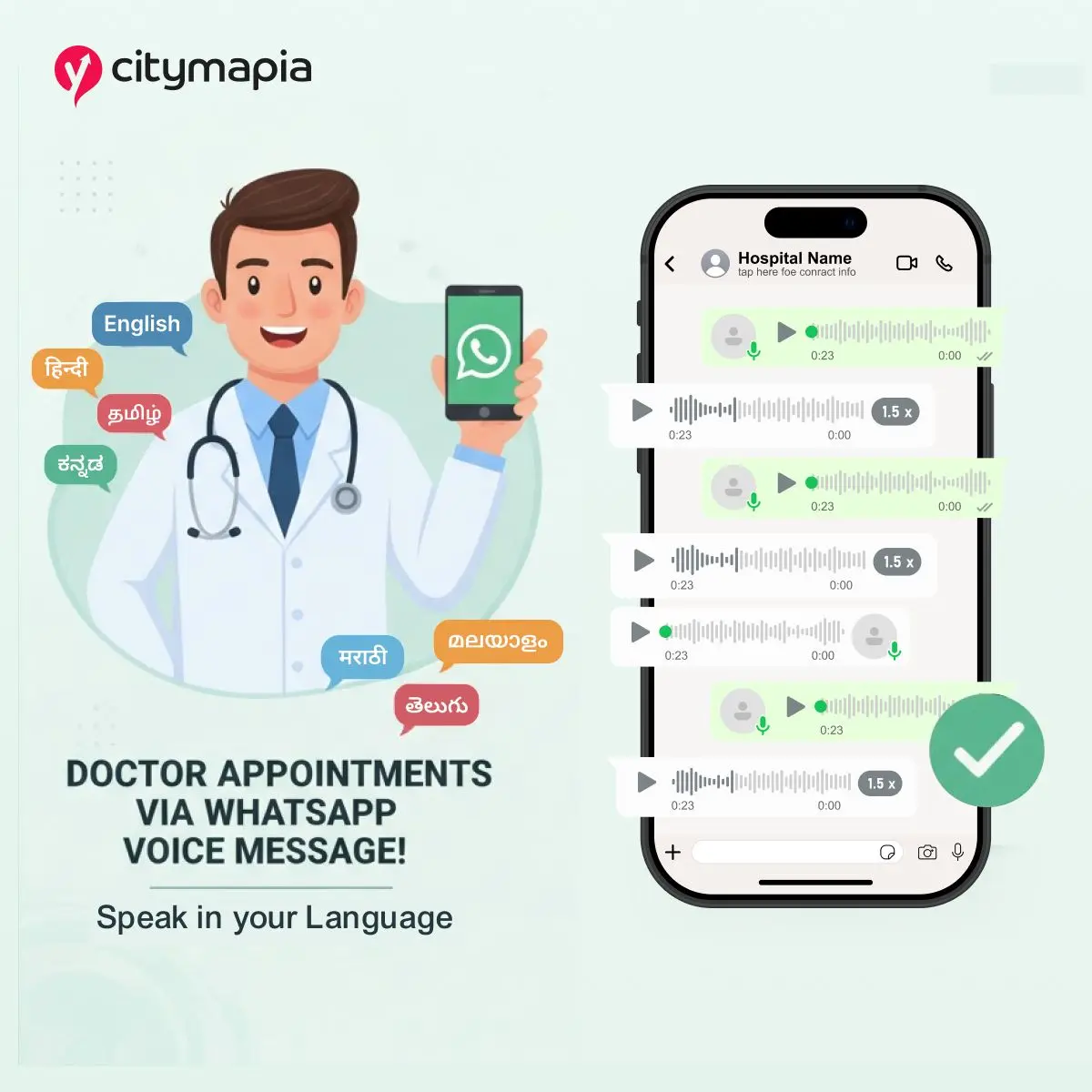
How WhatsApp AI Is Transforming Healthcare Appointment Booking
Patients don't want to sit on hold. Hospitals don't want to manage the manual chaos behind every scheduled slot. Voice-enabled AI on WhatsApp is starting to fix both problems at once.
Healthcare has a scheduling problem. Not a technology problem — a friction problem. Patients drop off when booking feels like a chore. Staff spend valuable hours routing calls and entering data that software should handle automatically. The result: missed appointments, lost revenue, and a front desk stuck doing work that adds no clinical value.
Conversational AI, embedded directly into WhatsApp, is changing how healthcare facilities capture and convert that demand. This post breaks down what that shift actually looks like, why WhatsApp is the right channel for it, and how Citymapia is building this infrastructure for hospitals and clinics today.
Why WhatsApp Is the Right Channel for Healthcare AI
Most AI health tools fail at the same point: adoption. Patients download apps they never open. Portals go unused. Phone lines stay congested because the "digital alternative" requires a login, a new account, and three tabs of navigation.
WhatsApp removes all of that. With over two billion active users globally, it's where patients already communicate — with family, with pharmacies, with local businesses. Asking them to book an appointment through the same app they use daily isn't a behavior change. It's just a new conversation in a familiar place.
Familiar UX means faster adoption
There's no onboarding required. No app store download. No username to recover. Patients send a voice note the way they already do, and the system handles the rest. That's a direct line between intent and action — which is exactly what healthcare facilities need more of.
- Works on every smartphone, regardless of operating system
- No additional login or account creation required
- Reaches patients in rural and semi-urban areas where WhatsApp penetration is highest
- Reduces time-to-booking compared to web forms or phone calls
The best patient-facing technology isn't the most advanced — it's the one patients will actually use without being taught how.
Regional language support closes the access gap
In markets like India, Southeast Asia, and the Middle East, a single healthcare facility may serve patients speaking five or more languages. English-only booking systems silently exclude large portions of the population — and that exclusion shows up directly in appointment volume.
Citymapia's underlying system processes voice input across numerous regional languages, accurately routing each request to the right department, time slot, and confirmation flow. This isn't a translation layer bolted on top — it's embedded in how the system parses intent from the beginning.
- Patients speak in the language they're most comfortable with
- The system routes correctly regardless of dialect or phrasing variation
- No human interpreter required in the loop
What Voice-to-Appointment Actually Looks Like
The technical flow is simpler than most hospital administrators expect — and that simplicity is what makes it scalable.
A patient sends a WhatsApp voice note: "I need to see a cardiologist on Thursday morning." The system transcribes the audio, parses the intent, checks available slots in the facility's scheduling system, and confirms the appointment — all within seconds. No hold music. No missed call. No callback required.
What happens in the background
- Voice input is transcribed and parsed for intent — specialty, date preference, urgency
- The system cross-references live availability in the facility's calendar
- A time slot is proposed and confirmed via WhatsApp reply
- The appointment is logged automatically — no manual data entry for staff
- Confirmation and reminders are sent through the same thread
Every appointment booked automatically is one less call your front desk has to take — and one less patient lost to a busy signal.
Operational impact for facilities
For hospitals and clinics integrated with Citymapia, the benefits go beyond patient experience. The operational gains are direct and measurable from day one.
- Staff processing capacity increases as manual booking volume drops
- Appointment no-show rates fall with automated reminders in the same thread
- Demand captured outside office hours — nights, weekends, public holidays
- Fewer dropped inquiries when phone lines are occupied
The Infrastructure Behind It
Booking through WhatsApp sounds simple on the surface. The engineering underneath it is not.
Citymapia builds this as infrastructure, not as a standalone tool. That means it integrates with a facility's existing scheduling systems, patient management software, and compliance requirements — rather than running parallel to them or requiring a full replacement.
- API-level integration with existing hospital management systems
- No dependency on staff to monitor a separate inbox or dashboard
- Built-in data handling aligned with healthcare data standards
- Scalable to multi-location networks without architecture changes
A clinic using Citymapia doesn't need to change how it manages appointments internally. It just starts capturing more of them.
Common Mistakes to Avoid
- Choosing tools that require patient behavior change — if patients have to download something or create a new account, most won't bother, and adoption stalls before it starts.
- Treating AI as a cost center instead of revenue infrastructure — every missed appointment is lost revenue; automation that reduces that attrition pays for itself quickly.
- Deploying without integration — a standalone chatbot that doesn't connect to your scheduling system creates more manual work, not less.
- Ignoring multilingual demand — facilities in diverse markets lose bookings daily from patients who can't navigate English-only systems.
Frequently Asked Questions
Does WhatsApp AI booking work for specialty departments, not just general consultations?
Yes. The intent-parsing layer can be configured to route requests to specific departments, specialists, or procedure types — based on how the facility structures its calendar and workflow.
How does the system handle voice input in regional languages?
Citymapia's underlying processing accurately interprets voice messages across multiple regional languages, routing each request correctly without requiring a human intermediary or a separate translation step.
What happens if a requested time slot isn't available?
The system proposes the nearest available alternatives in the same WhatsApp thread, allowing the patient to confirm a new slot without needing to call back or restart the process.
Will this work alongside our existing hospital management software?
Citymapia integrates via API with your current systems. You don't need to replace your scheduling software — the AI connects to what you already use and strengthens it.
How quickly can a facility go live with this system?
Deployment timelines vary by system complexity, but because there's no new software for staff or patients to adopt, onboarding is substantially faster than most enterprise healthcare technology rollouts.
Ready to Stop Losing Appointments to Friction?
See how Citymapia integrates voice AI into your scheduling workflow — without disrupting what already works.
Talk to Citymapia