Smart Doctor Booking: How Slot-Based Systems Work
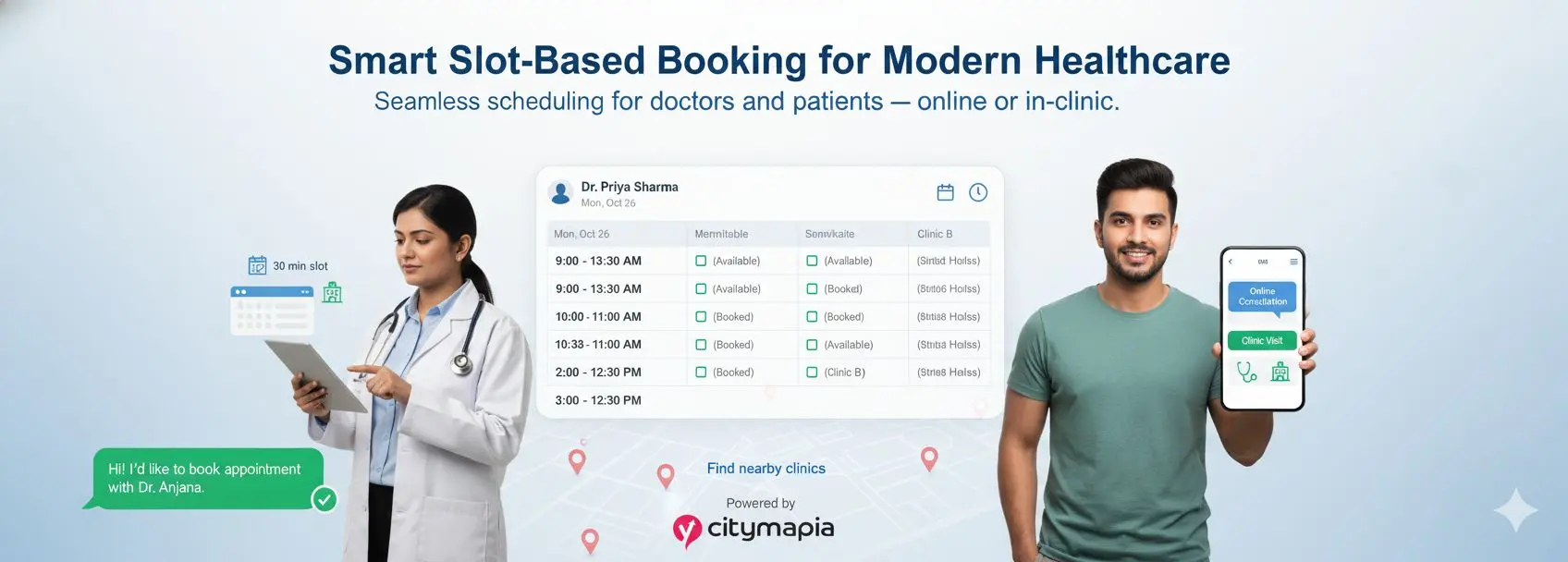
Smart Doctor Booking: How Slot-Based Systems Are Transforming Healthcare Scheduling
A missed appointment isn't just an inconvenience — it's a broken chain of trust between a patient and their doctor. And in most hospitals today, that chain breaks far too often.
Overloaded front desks. Phone queues that never end. Patients who show up at the wrong time, or don't show up at all. Doctors sitting idle between gaps they never planned for. The scheduling problem in healthcare is old, but the damage it causes is very real — to revenues, to patient satisfaction, and to clinical efficiency.
Slot-based doctor booking systems solve this at the root. Here's how the technology works, why it matters, and what a real-world deployment — built by Citymapia for Sreedhareeyam Ayurvedic Eye Hospital — looks like when it's done right.
What Is a Slot-Based Doctor Booking System?
Traditional appointment scheduling works on a simple first-come, first-served model. It's reactive, manual, and breaks the moment demand spikes. A slot-based system is different — it's structured, predictable, and designed to put both the patient and the doctor in control.
How It Works for Doctors
Doctors define their own availability — not just which days they work, but exactly how long each consultation should take, how many patients they can see per session, and whether they're available for online or in-clinic visits. The system builds their schedule around those rules, automatically.
- Set slot duration per consultation type
- Define separate availability for online and offline sessions
- Manage multiple clinic locations from one interface
- Block out time for breaks, emergencies, or admin without disrupting the queue
When doctors control their own time, they stop losing it. Slot-based scheduling turns calendar chaos into clinical precision.
How It Works for Patients
Patients see live availability — not a static list of "available" slots that may already be taken by the time they call. They choose based on their real-time options and complete the booking in minutes, without needing to call anyone.
- Browse nearby clinics and available doctors in real time
- Choose between online or in-clinic appointments
- Book directly through WhatsApp — no app download, no portal login
- Receive instant confirmation and reminders automatically
The Case Study: Citymapia and Sreedhareeyam
Sreedhareeyam Ayurvedic Eye Hospital & Research Centre is one of India's most respected Ayurvedic institutions — a facility where patient volumes are high, consultation types are varied, and both online and in-clinic demand exist simultaneously. That's a complex scheduling problem.
Citymapia built a custom slot-based booking platform specifically for their operations. The goal wasn't just to digitize appointments — it was to build an intelligent system that could handle the real-world complexity of running a multi-doctor, multi-format healthcare facility.
What Was Built
- Doctor-facing scheduling panels with full control over availability and preferences
- Patient-facing booking flows with real-time slot visibility
- Automated WhatsApp booking — patients could confirm appointments directly through chat without any human in the loop
- Unified management across both online consultations and physical clinic slots
Booking a doctor's appointment through WhatsApp isn't a feature — it's meeting patients exactly where they already are.
Why WhatsApp Matters Here
WhatsApp has over 500 million active users in India. It's not a secondary communication channel — for most patients, it's the primary one. Building the booking flow natively into WhatsApp meant zero friction: no app to install, no account to create, no portal to navigate. Patients already knew how to use the interface. They just needed it to do something new.
This is the principle that drives how Citymapia builds healthcare infrastructure — don't ask users to change their behavior, build systems that fit the behavior they already have.
Why Healthcare Scheduling Has Been Slow to Modernize
Most hospitals know their scheduling process is broken. The challenge isn't awareness — it's implementation. A few factors have kept healthcare scheduling stuck in older models for longer than it should have been.
The Fear of Disrupting Existing Workflows
Hospitals run on tight routines. Staff are trained to handle appointments a certain way, and the thought of migrating to a new system — especially while still seeing patients — feels high-risk. This hesitation is understandable. But modern scheduling systems are designed to layer on top of existing operations, not replace them overnight.
One-Size-Fits-All Software Doesn't Fit Healthcare
Generic booking tools weren't built for the specific demands of clinical environments. They don't account for appointment types, consultation lengths, multi-doctor coordination, or the distinction between in-person and teleconsultation. Sreedhareeyam needed a system built for how they actually operate — not adapted from something built for restaurants or salons.
- Custom logic for Ayurvedic consultation types
- Separate flows for new patients vs. follow-ups
- Integration with clinic-specific preferences and capacities
Common Mistakes to Avoid
- Going fully digital too fast — Patients aren't all equally tech-comfortable; a good system supports both digital and assisted booking in parallel.
- Ignoring the doctor-side UX — If doctors find the scheduling tool frustrating, they'll work around it, defeating the whole purpose.
- Treating reminders as optional — Automated appointment reminders can cut no-shows by 30–40%; they're not a nice-to-have.
- Building for today's volume only — Scheduling infrastructure should be built to scale as patient demand grows, not rebuilt every time it does.
Frequently Asked Questions
Can a slot-based booking system work for multi-specialty hospitals?
Yes — and it works especially well there. Each doctor or department can have completely independent scheduling rules, consultation durations, and availability windows, all managed from a single unified platform.
Does WhatsApp-based booking require patients to install anything?
No. Patients interact through their existing WhatsApp account. The automated booking flow is triggered via a chat interface — no app downloads, no new accounts, no friction.
How does the system handle online vs. in-clinic appointments differently?
Doctors can configure separate availability, slot durations, and capacity limits for each consultation type. A doctor might take 20-minute online slots in the morning and 40-minute in-clinic sessions in the afternoon — the system manages both without overlap.
How long does it take to deploy a system like this?
That depends on the complexity of the hospital's existing workflows. Citymapia builds systems that integrate with current operations rather than replacing them, which significantly reduces deployment time and staff retraining needs.
Is this kind of system only viable for large hospitals?
Not at all. Single-doctor clinics benefit just as much — often more — because every missed appointment or scheduling error has a direct and immediate impact on their operations. The system scales down just as well as it scales up.
Build Smarter Healthcare Infrastructure
See how Citymapia designs and deploys healthcare booking systems that work for patients, doctors, and administrators alike.
Explore Citymapia